

In the global pharmaceutical and nutraceutical industry, the hard gelatin capsule is one of the most widely used products. . Manufacturers use gelatin capsules as shells to hold medicines for patients. It is used for life-saving prescription medications to high-growth dietary supplements. Pharmaceutical and nutraceutical companies prefer these capsules because they offer excellent shelf-life stability and high consumer trust. For any capsule manufacturer or capsule manufacturing companies, understanding the manufacturing process, diverse applications, and rigorous quality standards associated with these capsules is crucial for the production or consumption of these essential dosage forms.

At Safrroys, we leverage decades of engineering expertise to design and manufacture the high-precision machinery that makes this consistency possible. Furthermore , as a leader in automatic hard capsule machines and turnkey manufacturing solutions, we view the capsule not just as a medicine shell, but as a masterpiece of industrial precision.
What Are Hard Gelatin Capsule?
A hard gelatin capsule is a two-piece cylindrical shell: a cylindrical-shaped body and a cap that contains medication or supplements of foods like Vitamin D in powder, granules, or pellet form. Manufacturers also fill some hard gelatin capsules with semi-solid formulations.
In simple terms, this gelatin capsule is a solid oral dosage form which covers unpleasant tastes and odours , make medicines easier to swallow, and protects them from moisture and air.

In simple terms, even small changes to the ingredients used to make a capsule—like the gelatin can alter how flexible the capsule becomes.
Because these small changes can affect how well the capsule protects the medicine or how easily it dissolves in the human body, capsule manufacturing companies must carefully test and prove that their production process works perfectly in every single time. This testing is called process validation, and it ensures every capsule is safe and effective.
Difference Between Hard Gel Capsules and Other Capsule Types
Essentially, HPMC capsules are better at handling high heat or very dry air without getting damaged, but gelatin capsules are still the top choice for most companies.
This is because gelatin capsules are much cheaper to buy and work faster and more reliably on high-speed factory machines. For big companies making millions of supplements or medicines, gelatin is the most practical and cost-effective option. To maximize product reliability and customer interest, it is essential for the capsule manufacturer to understand these differences.
| Feature | Hard Gelatin Capsule | Hard Gel Capsules | HPMC (Veggie) Capsules |
|---|---|---|---|
| Structure | Two-piece (Cap & Body) | One-piece (Hermetic seal) | Two-piece (Cap & Body) |
| Typical Fill | Dry solids (powders, pellets) | Liquids, oils, pastes | Dry solids |
| Source | Animal Collagen | Animal Collagen | Plant Cellulose |
| Moisture Content | High (13% – 16%) | Moderate to High | Low (2% -6%) |
| Cost | Most economical | More expensive | Mid-to-high cost |
| Stability | Sensitive to humidity | Sensitive to heat/UV | Highly stable |
Raw Materials Used in Hard Gelatin Capsule
Primarily, manufacturers use gelatin (derived from animal collagen) and purified water (12–16%) to produce hard gelatin capsules. In addition, they add colorants, opacifiers, plasticizers to improve flexibility, and preservatives to enhance stability. Together, these ingredients form a durable capsule shell that safely contains powders, granules, or pellets.These ingredients form a layer that releases the medication when it dissolves in the human body.
For example, manufacturers often face color uniformity challenges when they do not control pigment dispersion properly during gelatin preparation.
Key Components
- Gelatin: Manufacturers produce the main component which is gelatin, from animal collagen (skin, bones), which gives the shell its shape.
- Water: Usually, 12–16% is necessary for the gelatin’s formation properties.
- Plasticizers: The substances, such as sorbitol or glycerol, which are added to the shell to prevent stiffness and increase its flexibility.
- Pigments and colorants: Pigments and colorants, such as iron oxides and titanium dioxide, are used for both differentiation and visual appeal.
- Opacifiers: Titanium dioxide, for example, is used to make capsules opaque and protect drugs that are sensitive to light.
- Preservatives: Used to prevent the growth of microorganisms.
Finding accessible, compliant raw materials is essential for any responsible capsule manufacturer to create a gelatin capsule that is both secure and effective.
Step-by-Step Hard Gelatin Capsule Manufacturing Process
Manufacturers produce hard gelatin capsules using the dip coating technique. They dip stainless steel pins into a heated gelatin solution to form the capsule body and cap. Next, they dry the coated shells under controlled conditions before stripping, trimming, joining, and printing them if required. In addition, they use colorants, plasticizers, preservatives, and opacifiers to improve durability, appearance, and product stability. Because inconsistent gelatin viscosity can cause variations in wall thickness, manufacturers must carefully control the coating process to ensure every hard gelatin capsule has uniform thickness, strength, and quality.
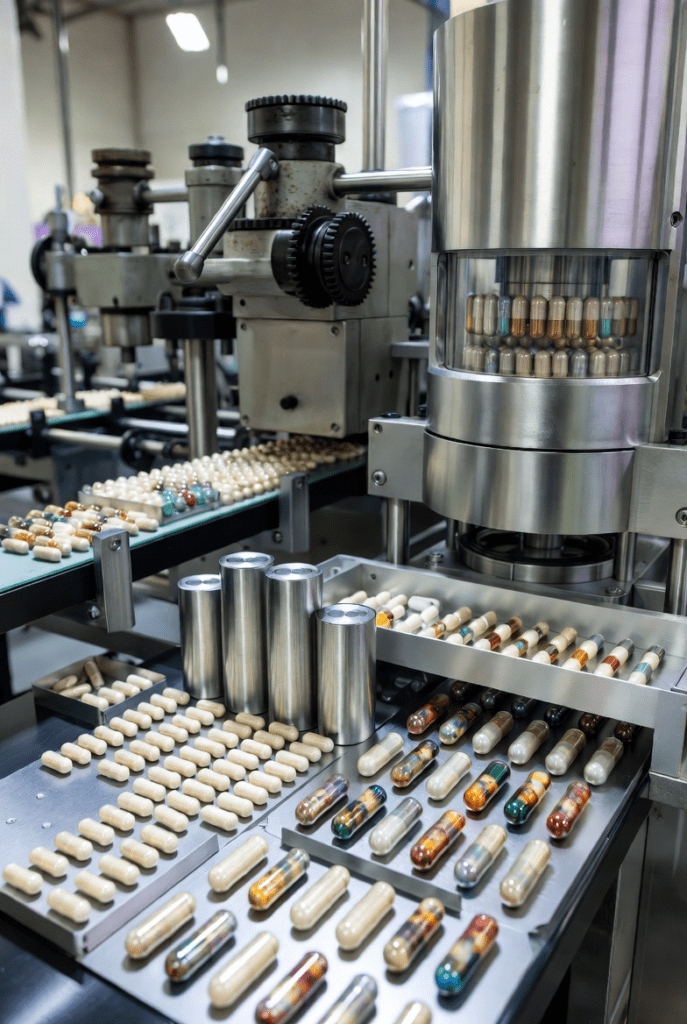
Here’s a step-by-step breakdown:
- Gelatin Preparation: First, manufacturers dissolve gelatin in purified water at a controlled temperature to create a homogeneous solution.
- Dipping: Next, they dip stainless steel pins into the gelatin solution to form the capsule body and cap. This step determines the wall thickness of each hard gelatin capsule.
- Drying: After that, manufacturers dry the capsule shells under carefully controlled temperature and humidity conditions. Proper drying keeps each hard gelatin capsule strong and dimensionally uniform. Therefore, maintaining precise humidity levels during this stage helps prevent shell defects and weaknesses.
- Stripping and Trimming: Then, manufacturers remove the dried capsule shells from the pins and trim them to precise lengths, ensuring a secure fit between the capsule body and cap.
- Joining and Inspection: After joining the caps to the bodies, they are examined for defects. Advanced capsule manufacturer use automated vision systems to find any defects, splits, or deviations in color.
Common Manufacturing Challenges in Hard Gelatin Capsules
Even with high-tech machines, making gelatin capsules is difficult in real life and for that it is requires the expert engineers to keep everything running perfectly.
Repair and Maintenance of the Shell
- Capsule shells require balanced moisture content and uniform wall thickness to maintain strength and flexibility. Excess moisture can make the shell soft and sticky, while low moisture can cause brittleness and cracking. Inconsistent gelatin viscosity, dull cutting knives, or insufficient plasticizer may also lead to uneven wall thickness and shell splitting. Therefore, manufacturers must carefully control both raw materials and processing conditions to produce durable, high-quality hard gelatin capsules.
Manufacturing Errors and/or Errors due to Filling
- If operators do not calibrate the capsule-filling machine correctly, the capsule may not align properly with the cap. Furthermore, incorrect vacuum settings can remove too much powder or allow excess powder to enter the capsule. Low vacuum pressure also creates weak seals, while insufficient vacuum during filling can produce partially filled or empty capsules. As a result, manufacturers increase the risk of contamination, product rejection, and costly rework.
Formulation and Material Errors
- Formulation and Material Errors: Capsule shells need to maintain the proper moisture content in order to provide strength and flexibility. Moisture levels too high or too low will be the major contributor to a weakened shell. In addition, manufacturers must carefully control gelatin quality, raw materials, and processing conditions. Otherwise, the capsules may not withstand the stresses of filling, packaging, and shipping.
Quality Standards & Compliance in Hard Gelatin Capsule Manufacturing
For every capsule manufacturer, quality control is key to their reputation. These capsules must be produced in compliance with international regulatory systems, which include:
- Good Manufacturing Practices (GMP): guarantees continuous output and quality, encompassing everything from training employees to building layout.
- Furthermore, pharmacopeial standards such as USP (United States), EP (European), and BP (British) establish mandatory quality benchmarks for hard gelatin capsules, including disintegration time, moisture content, and impurity limits.
- ISO quality management systems: Quality management systems provide a framework for overall quality assurance.
Experienced capsule manufacturer view drying parameters as more than just a production phase; it’s a crucial quality parameter.
Common Applications of Hard Gelatin Capsule
The hard gelatin capsule’s adaptability makes it appropriate for a variety of industries:
| Industry Sector | Primary Use Cases | Key Technical Benefits |
|---|---|---|
| Pharmaceuticals | Antibiotics, Analgesics, Cardiovascular drugs, and Antivirals. | Ensures precise dosing and predictable drug release profiles; protects sensitive medicines from light and oxygen. |
| Nutraceuticals | Multivitamins, Minerals, Amino acids, and Herbal extracts. | Due to its ease of swallowing, it is highly accepted by consumers and offers an economical choice than tablets. |
| Dietary Supplements | Probiotics, Fiber supplements, and Weight management formulas. | increases fast nutritional absorption and digestion in the body |
| Specialty Medicine | Multi-particulate systems (Sustained Release pellets), and combination therapies. | Offers as a flexible delivery method for specialized formulations such as liquid-dry mixtures and mini-tablets. |
How to Choose a Reliable Capsule Manufacturer
Strong regulatory compliance (GMP, ISO, FDA), strong quality control (in-house testing, raw material checks), decades of experience, an outstanding track record (client reviews), and flexible manufacturing capabilities (customization, flexible production, R&D support) are all important considerations when choosing a trustworthy capsule manufacturer. Make sure the Capsule manufacturing companies can satisfy your needs and provide fair pricing, efficient logistical support, and extensive services like packaging.
So, working with an experienced capsule manufacturer guarantees steady performance, regulatory trust, and sustained profitability for pharmaceutical and nutraceutical companies. Capsule manufacturing companies that put an emphasis on innovation and compliance will continue to dominate the market as demand increases on a worldwide scale.