
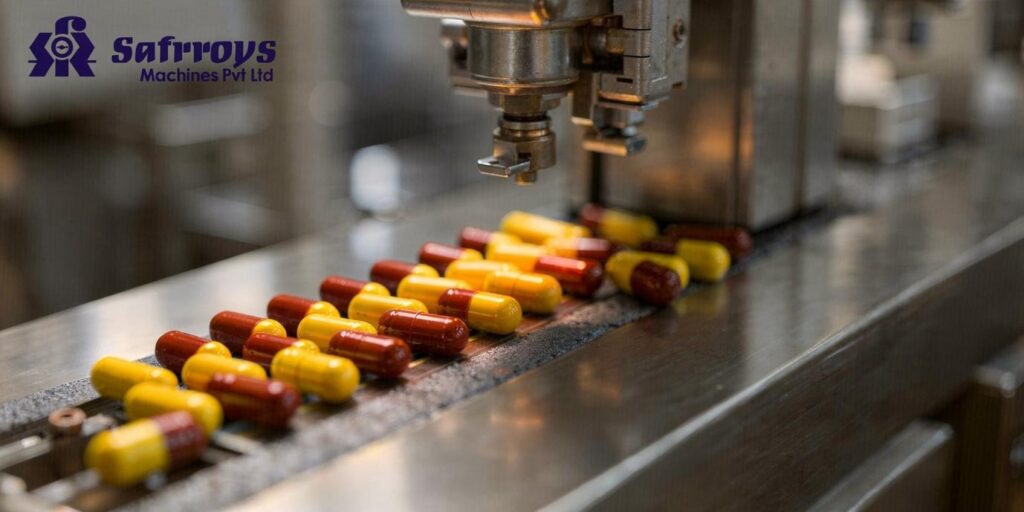
Understanding Capsule Manufacturing Machines
Today, a Capsule Manufacturing Machine forms the foundation of modern pharmaceutical and nutraceutical capsule production. It enables manufacturers to produce high-quality hard gelatin and HPMC capsules with precision, consistency, and efficiency. As a result, manufacturers can improve productivity, maintain GMP compliance, and meet the growing demand for high-quality capsules.
This guide explains how a Capsule Manufacturing Machine works, the different machine types available, their applications, and the key factors to consider before investing in one.
What Is a Capsule Manufacturing Machine?
A Capsule Manufacturing Machine is equipment that is used make a lot of high-quality capsules in various sizes every day. They can create vegetarian capsules, empty hard gelatin capsules, and liquid-filling or solid ingredients filling capsules.
In order to maintain a safe, accurate dosage of the medicines, a uniform size, and the quality standards of the capsules, it is required for the capsule manufacturing companies to invest in a modern capsule making machine.
So, the capsule making machine is the core of the oral solid dosage (OSD) unit, whether it is set up in a large factory or a small drugstore. Reputable capsule manufacturers make significant investments in automation to boost productivity, lower the risk of discoloration, and preserve uniformity between batches.
In operational GMP facilities, capsule machines typically qualified under IQ/OQ/PQ protocols before to the start of commercial production.
Modern capsule making machines are designed to ensure:
- Uniform shell thickness
- Consistent capsule locking
- Controlled moisture balance
- Repeatable batch-to-batch output

Typical Technical Specifications of Industrial Capsule Machines
Manufacturers design large-scale capsule production machines to operate within accepted industry limits.
| Parameter | Typical Industry Range |
| Capsule sizes | 000, 00, 0, 1, 2, 3, 4, 5 |
| Shell wall thickness | 0.07 – 0.12 mm |
| Gelatin moisture content | 13 – 16% |
| Drying tunnel temperature | 22 – 30°C (controlled) |
| Fill weight accuracy | ±2% to ±3% |
| Capsule locking force | Standardized to prevent leakage |
These specifications are widely referenced by pharmaceutical engineers and quality auditors.
Types of Capsule Making Machines
When looking through options from different companies that manufacture capsules, you will discover three main types of machinery. Each contributes to a particular budget and output volume.
- Manual Capsule Filling Machines: Operators manually fill hard gelatin capsules with medicines or food supplements in powder or pellet form. Therefore, these machines are ideal for research laboratories, startups, and small-scale manufacturers because they offer a cost-effective solution for low-volume production.
- Semi-Automatic Capsule Filling Machines: These machines combine automated filling and sealing with manual capsule loading. As a result, they provide an excellent balance between productivity and affordability. Consequently, many capsule manufacturing companies recommend semi-automatic machines for startups and growing pharmaceutical businesses.
- Automatic Capsule Filling Machines: These machines are the preferred choice for large-scale pharmaceutical production. Moreover, they perform capsule separation, filling, sealing, locking, and extraction at high speed with exceptional accuracy. As a result, manufacturers can produce millions of capsules while maintaining consistent quality and operational efficiency. Therefore, fully automatic capsule manufacturing machines are essential for high-volume commercial manufacturing.
Which Capsule Manufacturing Machine is Right for your facility?
| Facility Type | Recommended Machine | Reason |
| Startup Pharma | Semi-Automatic | Lower CAPEX, faster learning curve |
| Contract Manufacturer | Automatic (65k–100k capsules/hr) | Batch flexibility with scalable output |
| Large Pharma | High-speed Automatic | Continuous production and compliance readiness |
We at Safrroys continuously develop and upgrade our machines and technology so that our customers are able to produce the best quality and maximum quantity of capsules with minimum effort.
We have the following capsule making machine models:
- SFR XAL-2A: Up to 160,000 capsules/hour, servo-driven architecture, designed for high-throughput GMP facilities.
- SFR XAL: Up to 100,000 capsules/hour, PLC-controlled, widely adopted for consistent commercial production.
- SFR 901 XAL-V: Specialized for HPMC and cellulose capsules, energy-efficient design.
- SFR XAL-Ecoline: 65,000 capsules/hour, optimized for cost-sensitive operations without compromising quality.
How a Gelatin Capsule Machine Works
The way a gelatin capsule machine works is a remarkable example of mechanical accuracy. A gelatin capsule machine’s performance is based on regulated heating and exact shaping. Stainless steel pins are first dipped into a gelatin solution to make capsule bodies and capsules. To make the capsule durable, the manufacturers need to monitor the temperature and humidity carefully during the production process.
A capsule manufacturing machine separates the body and cap of the capsules accurately, fill the body with the formulation, and seal the capsule during filling operations. Advanced devices guarantee accurate dosage of the formulation and the thickness of the shell wall.
In real-world production, maintaining consistent gelatin viscosity during dipping is critical. In GMP audits, inconsistent viscosity is one of the most common causes of gelatin bloom failure and shell deformation.
Key Components of Capsule Manufacturing Machines
Each capsule production machine is made up of a variety of essential parts that guarantee accuracy and effectiveness:
- Gelatin Heating System: maintains the right texture in a gelatin capsule machine so that capsules can form properly.
- Dipping mechanism: Capsule wall thickness and smoothness are controlled by the dipping mechanism.
- Drying Tunnels: Control temperature and humidity
- Filling Parts: Carefully inject pellets or powders into the empty capsule.
- Sealing Systems: Tightly hold the capsule pieces
- Control Panel: Enables rapid observation of the capsule manufacturing process.
Common Manufacturing Defects & How Machines Prevent Them
Manufacturers must actively manage several major risks during industrial capsule production, including:
| Defect | Primary Cause |
| Shell cracking | Low moisture content, excessive drying |
| Incomplete locking | Dimensional variation, poor alignment |
| Powder leakage | Improper capsule fit or weak locking |
| Weight variation | Inconsistent filling mechanism |
| Gelatin bloom failure | Incorrect gelatin viscosity |
| Humidity-induced deformation | Poor environmental control |
Production Capacity & Output Considerations
Production Capacity by Machine Type
Overall, Production capacity of a machine is a major factor for the capsule manufacturer to choose the correct capsule manufacturing machine. A high-speed automatic capsule production machine can manufacture over 150,000 capsules per hour, while small-scale manual devices might only make 1,000 capsules per hour.
Furthermore, Production capacity varies by machine type:
- Manual: approx. 1,000 capsules/hour
- Semi-automatic: 20,000–40,000 capsules/hour
- Automatic: 65,000–160,000+ capsules/hour
Benefits of High-Speed Capsule Manufacturing
Furthermore, an advanced capsule making machine can significantly increase production output without compromising product quality. As a result, contract manufacturers and pharmaceutical companies can improve productivity while maintaining consistent manufacturing standards. Moreover, manufacturers develop industrial hard gelatin capsule machines using advanced engineering techniques that combine precision mechanical design with a thorough understanding of capsule shell formation and high-speed production requirements. Consequently, these machines deliver reliable performance, consistent capsule quality, and long-term operational efficiency in commercial manufacturing environments.
Automation and Control Systems
Modern capsule manufacturing machines use servo motors and high-precision components to ensure accurate timing and reliable operation. In addition, energy-efficient technology reduces power consumption while supporting high-speed production. Manufacturers also offer multiple configurations, including 6-, 7-, and 9-bar dipping systems, to meet different production requirements.
PLC and HMI Integration
A PLC and touchscreen HMI control the entire gelatin capsule manufacturing process. The system enables operators to store production formulas, generate tamper-proof printouts, and comply with stringent FDA regulations. As a result, manufacturers can improve process control, maintain production records, and ensure consistent product quality.
Safety and Operational Efficiency
Safety remains a top priority with features such as Smart Start and Inching, which protect machine components and simplify setup. However, fully automatic machines are not always the ideal choice. Due to higher maintenance and validation costs, facilities operating below 60% capacity may experience higher production costs per capsule.
However, Automatic devices are not always the ideal option. Due to maintenance and validation expenses, facilities with less than 60% efficiency frequently have higher per-capsule costs.
Capsule Manufacturing Machines & Regulatory Compliance
Manufacturers typically design capsule manufacturing machines to comply with:
- WHO GMP guidelines for pharmaceutical equipment
- FDA 21 CFR Part 210 & 211 for oral solid dosage forms
- Data integrity and validation readiness expectations
Moreover, regulators constantly assess environmental control, equipment qualification, and batch transparency related to capsule machines during inspections.
Industries Using Capsule Manufacturing Machines
Pharmaceutical manufacturers primarily use gelatin capsule machines; however, various industries have begun to utilize this technology:
- Nutraceuticals: Vitamins, minerals, and herbal supplements, high demand has increased the demand for this gelatin capsule machine
- Cosmeceuticals: Manufacturers use gelatin capsules to encapsulate specialty cosmetic oils and skincare formulations.
- Veterinary Medicine: Manufacturers use these capsules to deliver animal health products safely and accurately.
How to Choose the Right Capsule Manufacturing Partner
It is very important to choose the right Capsule Manufacturing Partner to increase your brand awareness. Reputable capsule manufacturers provide technological guidance, compliance documentation, and long-term maintenance services. Before choosing capsule manufacturing companies, make sure to evaluate their capsule manufacturing machines’ efficiency level, GMP compliance, and after-sales assistance. Selecting a gelatin capsule machine from a supplier with a track record of success guarantees that your production line will continue to run for many years.
Before selecting a capsule manufacturing machine, manufacturers typically assess the following factors:
- Regulatory compliance readiness
- Process stability and repeatability
- Environmental control capability
- Maintenance accessibility
- After-sales technical support
Manufacturers design capsule manufacturing machines to comply with GMP guidelines and global pharmaceutical manufacturing standards. These machines help companies meet FDA and international regulatory requirements.